If the cruelty and infidelity of the beloved are not taken into the reckoning:
What means the Grace and Mercy of God? What is there?
The ascetic desired drink from the Fountain of Paradise, and Ḥāfiẓ from the
wine-cup;
God’s Will ’twixt the two? We shall see what is there.
—Hafiz
‘Modern Muslims’, declared Shahab Ahmed, suffer the ‘existential problem of living in terms of a conceptual incoherence with their past.’ This rather dire state of affairs motivated the late academic’s enormous, sprawling and formidable masterpiece, What is Islam? The Importance of Being Islamic. Ahmed died in 2015 at age 48, and the book was published posthumously. He was never able to answer his critics.
Ahmed’s book has been widely attacked and caricatured as an eccentric attempt by a Muslim to justify drinking wine. The most regularly cited section is its opening, which recounts a conversation at a Princeton University dinner between a Cambridge philosopher and a Muslim academic “indulging in a glass of wine”.
The Cambridge don is troubled by this; the academic explains his family “have been Muslims for a thousand years” and are “Muslim wine-drinkers”.
“I don’t understand,” says the don.
“Yes, I know,” the Muslim responds cryptically, “but I do.”
In a coruscating review of the book, Irfan Ahmad argues that Ahmed’s “vignette seems to announce that, as a Muslim, perhaps one from the subcontinent, he too is ‘modern,’ not ‘orthodox.’ After all, to the ‘uncivilized’ world, modernity meant wine and Christianity.” Ahmed has been variously accused by his critics of claiming that Islam is whatever Muslims say it is; that Islam is whatever Muslims have done throughout history; even that Islam doesn’t really exist as a coherent category—the list goes on.
I want to revisit Ahmed’s historical study, not to summarise it adequately, which would be impossible in the space of an essay, but to draw out some of its most important and misunderstood arguments. The critics are wrong. What is Islam? is a magnificent work, and its implications are as important—and nearly as unexplored—today as they were when it was first published.
Defending the Idea of an Islamic World
The book is dense but wonderfully rich, packed with rare sources in a range of languages (Ahmed was a master of perhaps 15). Of Pakistani heritage, he was raised in Malaysia and educated at an English boarding school. He dabbled in journalism and travelled widely (once playing cricket with a pre-terrorist Osama bin Laden in Pakistan), before eventually ending up at Harvard as a postdoctoral fellow. What is Islam? draws on a profound engagement with literature, particularly poetry, and is motivated in part by an evident frustration with both academic and popular discourse about Islam.
Damningly, Ahmed accuses academics of failing “to provide answers about the relationship to ‘Islam’ of a range of basic historical phenomena”. He was frustrated by the tendency of both academics and ordinary Muslims to view Islam only as religion or law, and the resulting inability to adequately comprehend the depth and breadth of Islamic history. In many cases, through failing to understand how Muslims could live “by norms that are apparently so at odds with the legal while simultaneously understanding those other norms to be somehow compatible with and/or expressive of Islam”, scholarly discourse ends up “concluding that the practitioners of the phenomena were themselves unable to make sense of them and, hence, were just bad Muslims, or were Muslims who just did not think about, or feel the need for, living in a coherent way that makes existential and cosmological sense”. Many Muslims today, we might add, tend to look upon much of Islamic history, for example the high culture of Mughal India (with all its wine-drinking, figural painting and music), with disapproval, suspicion, or simple bewilderment.
Ahmed opposes the fashionable academic notion that Islam “is simply what Muslims everywhere say it is”, since this would make human and historical Islam incoherent, a “diffuse plurality… the proponents of this view have blinked at the kaleidoscope of human and historical Islam and concluded that it has no template or mechanism or spokesperson, but at best only an assortment of local patterns and voices”. Indeed, many historians dismiss the idea that there was an “Islamic world”, seeing this as essentialising. In contrast, Ahmed points to “the idea, which I venture is universally held and experienced among Muslims, that each of them… is simultaneously a member of a universal community” of Muslims. He cites the “profound degree to which Muslims from different places feel each other’s experience of injustice and suffering, and are motivated to act on the basis of that identification.”
Moreover, Islam has been a cosmopolitan and universal historical phenomenon since its inception. “Islam never enjoyed a honeymoon period in which to sedately articulate its identity in a parochial context,” Ahmed writes. It grew up and had to articulate itself in the most ethnically, linguistically, and culturally diverse and diffuse historical environment imaginable. One of Ahmed’s greatest contributions to academic discourse is his idea of the “Balkans-to-Bengal complex” in the period 1350–1850, the “most geographically, demographically and temporally extensive instance of a highly-articulated shared paradigm of life and thought in the history of Muslims”.
Ahmed’s focus on the Balkans-to-Bengal complex, as a sort of gigantic case study, puts the West and East of the Islamic world (in particular, the Ottoman and Mughal Empires) into conversation, while also correcting the tendency to “marginalise and disenfranchise” them in historical study. By examining Islam’s post-formative period, he challenges older narratives of a medieval Golden Age which gave way to terminal decline.
This also de-centres the Arabic-speaking world, although Irfan Ahmad’s claim that the book is predicated “on a dualism between Arab Islam as ‘prescriptive’ and non-Arab Islam as ‘explorative’” is unconvincing. Some of the thinkers who Ahmed cites as influential in the Balkans-to-Bengal complex were medieval Arabs, while “what we might call the ‘Old World’ of Islam - that is, the historically significant societies of Arabic-speaking Muslims of Egypt, Syria, Palestine, ʿIraq, and the Hijaz - were under Ottoman rule and thus directly under the paradigmatic influence of the norms of the Balkans- to- Bengal complex.”
So how does Islam draw Istanbul, Tirana and Lahore together as a single “complex”? In defining Islam, Ahmed is at pains to say he is “precisely not seeking to tell the reader what Islam is as a matter of Divine Command, and thus am not seeking to prescribe how Islam should be followed as the means to existential salvation.” Instead, he is seeking to conceptualise the “historical and human phenomenon that is Islam in its plenitude and complexity of meaning”. Crucially, this means that the label “Islamic” does not confer moral judgement onto what is being described. Fundamentally, this is a historian’s, not a theologian’s, definition of Islam, although Ahmed discusses the implications of his argument for modern Muslims.
He conceptualises historical Islam as “hermeneutical engagement” (in plain English, essentially “meaning-making”) with the “entire phenomenon and matrix of Revelation, rather than just the Text of Revelation”. This includes Muslim engagement with the “Pre-Text, Text and Con-Text of Divine Revelation”. The Pre-Text is the unseen reality behind the Quran—“Real-Truth”—and the Con-Text is the ideas and culture resulting from human engagement with Revelation. Engagement with the Pre-Text (unseen reality) both influences and is influenced by the Con-Text, which Ahmed describes as the “centuries-old city of Islam, a great and sprawling city consisting of various edifices erected for the various purposes of living by Muslims of bygone and present times”.
What, exactly, is the importance of this strenuous exercise in seeking analytical clarity? We are presented with the New York Metropolitan Museum’s torturously titled “New Galleries of the Art of the Arab Lands, Turkey, Iran, Central Asia, and Later South Asia”. Apparently, the term “Islamic art” was not considered appropriate, a decision which robbed gallery visitors of a proper understanding of what the various displayed artefacts actually meant to Muslims who created and engaged with them.
The purpose for historians and analysts is not to go around labelling everything “Islamic” or “non-Islamic” (note that this was not a term used or needed throughout most of Islamic history) but to ask, when confronted by a phenomenon or object: “what meaning is added by qualifying that phenomenon or object by the word Islamic?” Conversely, if we do not use the term Islamic, are we distorting or depleting that phenomenon or object—and thereby failing to truly understand it?
Not all art produced by Muslims can or should be described as Islamic. Instead, Ahmed tells us, “art is Islamic to the extent and in the manner that it is expressive of meaning in terms of hermeneutical engagement with Revelation to Muḥammad”—the entire matrix of Revelation.
Islam and the Ghazal
Ahmed sees the category of “religion” as unhelpful. It emerged “cast in the mould of a particular historical context and experience: that of historical European Christianity cut down to size and put in its place by the Enlightenment”. The Arabic term din is conventionally mistranslated as religion. Ahmed writes that European colonialism, and the secularising projects of modern Muslim states (most obviously Turkey), imposed the European binary of religious and secular on Muslims.
Importantly, however, Ahmed also explodes the idea of Islam as being mostly defined by law. He quotes Wael Hallaq, who says: “It would in no way be an exaggeration to argue that law was the defining characteristic of Muslim societies and civilizations throughout the centuries, and in every corner of the Islamic world”. According to Hallaq, “law defined not only the Muslim way of life, but also the entire culture and psyche of Muslims throughout fourteen centuries”. Ahmed denounces this as “reductionist nonsense”. He also criticises Marshall Hodgson, who famously proposed labelling the “social and cultural complex historically associated with Islam and the Muslims” not as “Islamic”, which he argued specifically denotes the religious, but as “Islamicate”.
The inadequacy of these conceptualisations is evident in the significance of poetry in the Balkans-to-Bengal complex. The literary canon, Ahmed explains, constituted “the most read, recited and invoked texts of Muslim self-expression”, which undermines the idea that Islam is defined by orthodoxy, law and prescription. Poetry, more often, is about exploration: “To conceptualize Islam first and foremost in terms of a concern to prescribe the correct is to lose sight of Islam as an undertaking to explore the meaningful.” As the 19th-century Persian and Urdu poet Mirza Ghalib of Delhi put it: “Brother, poetry is the creation of meaning; it is not the measuring out of rhyme!”
A society where poetry is popular and important can think metaphorically. Through metaphor, Ahmed writes, words can say more than they mean; “metaphor thus functions as a means by which Muslims reach upwards, inwards, and outwards beyond the form of the word.” The observable world is, in a sense, “the World of Metaphor, the experience of which evokes and alludes to the Real-Truth of the Unseen world”, the Pre-Text of Ahmed’s definition of Islam. Ghazal poetry is defined by metaphor, ambiguity, and ambivalence. Today it is common for Western Muslims to chide fans of translated poems by Mawlana Jalal-ud-Din Rumi for wrongly assuming that they refer to romantic love rather than the love of God. But the truth is more complex:
Love in the ghazal is at once carnal love, as well as chaste Platonic love, and love for/of the Divine; the beloved is at once the tantalizing fleshly object of physical desire, as well a beautiful youth who manifests and thus bears witness (shāhid) by virtue of his/her chaste beauty to the Beauty of the Divine, or is simply God Himself; the wine of the ghazal is at once the red liquid imbibed in metal cups by boon-companions in their social gatherings (majlis, maḥfil) where the ghazal is recited (both in literary conceit and in actual social practice), and/or an image that conveys the experience of intoxication with the Divine.
So is ghazal poetry religious or secular, sacred or profane? The categories make little sense. How can Rumi’s Masnavi, his magnum opus, fit into the “culture” rather than “religion” category, given that he described it as the “clearest proof of God”?
Importantly, poetry was not simply a feature of high culture; it was the most important and pervasive expression of philosophical and mystical ideas. To be familiar with the ghazal poetry of Hafiz of Shiraz was “a sine qua non for an Ottoman Muslim gentleman to function in society”, but Ahmed argues for the “centrality of the Dīvān of Ḥāfiẓ to the constitution of a paradigm of identity for Muslims in the world of the Balkans- to- Bengal complex”. The norms of the Muslim elite “were not hermetically isolated in high society but, rather, were part of an active economy of circulation of norms”. In particular, Sufi shrines (where poetry was recited or sung) were “prodigious social sites of conceptual and praxial contact between elites and commons”, since elite figures or ruling dynasties often patronised them, while both elites and ordinary people, most of whom were illiterate, frequented them.
Ahmed argues that the decline of poetry in the modern period radically transformed Islam. Persian was the “language of self- cultivation and written communication of educated Muslims”, and when this ceased to be, it meant the “historical disintegration of the Balkans- to- Bengal complex”. Losing the poetic language of metaphor, paradox, and ambiguity meant the “radical diminution” of Muslim thought and expression.
Historical Islam is characterised by radical contradiction, which prevailing conceptions generally struggle to make sense of. Poetry is a case in point: Hafiz’s poetry was highly mystical but also criticised and even mocked the ulema, jurists, and legal norms. Consider the following couplet:
Ḥāfiẓ; drink wine, live in non- conforming- libertinage [rindī], be
happy, but do not
Like others, make the Qur’ān a snare of deception.
Or this one:
If the jurist admonishes you against love- play,
Give him a bowl of wine; tell him to loosen his mind!
According to Ahmed, this poetry is thoroughly Islamic.
The Hierarchy of Knowing
For Ahmed, the way to make sense of ghazal poetry and much more is through the idea of Islam as encompassing coherent contradiction. “A prominent and permanent thread of the history of Muslims,” he tells us, “has been the struggle to arrive at a coherent working relationship in society between the respective truth-claims of law and of Sufism—a challenge to negotiate a sort-of Balance of Truth”. Crucial here is the idea that “God’s Truth is a differentiated truth of many layers - differentiated, that is, according to the capacity of the hierarchy of layers of individuals in society to know it”. In pointing to Muslim engagement with the “Pre-Text” of Revelation, Ahmed quotes the Quranic verse:
We will show them our Signs on the horizons and in themselves - until it becomes clear to them that it is the Truth.
To illustrate the presence of a hierarchy of knowing, he points to another Quranic verse:
We raise in degrees whomsoever we will, and above every possessor of knowledge is one who knows.
Ahmed argues:
… while hardly enfranchising, this notion of society and polity is neither discriminatory as regards fundamental public legal rights, nor does it posit any ontological difference between persons - since the distinguishing human quality is knowledge, which is something potentially susceptible to acquisition by all people.
Ahmed did not invent this idea. Consider the proclamation by the medieval philosopher Ibn Sina:
Now, it is obvious that the Realization-of-Truth. . . cannot be communicated to the multitude . . . Upon my life, if God the Exalted did charge a Messenger that he should communicate the Real-Truths of these matters to the masses with their dull natures and with their perceptions tied down to pure sensibles, and then constrained him to pursue relentlessly and successfully the task of bringing faith and salvation to the multitude . . . then He has certainly laid upon him a duty incapable of fulfillment by any man!
Then there is the proclamation of the Andalusian scholar Muhyi al-Din Ibn ‘Arabi, known as Shaykh al-Akbar (the Greatest Shaykh) and whose ideas were studied by elites from the Balkans to Bengal:
The jurists in every age have been, and still are, in relation to those who have realized Truth at the station of pharaohs in relation to prophets.
Not long afterwards, Rumi explained:
Law is like a candle that shows the way: Without the candle in hand, there is no setting forth on the road. And when you are on the road: that journey is the Way; and when you have reached the destination, that is the Real-Truth. It is in this regard that they say “If the Real- Truths are manifest, the laws are nullified”.
Philosophers argue that human reason can access higher Truths of the Divine. For Sufis, as Ahmed writes, it can be accessed “by personal revelatory experience”. Yet this is hardly the stereotypical fuzzy idea of free-for-all Sufism:
the means by which the individual develops his/her capacity to know are socially-instructed and objective. Hence, Sufism is not a freelance, anything-goes sort of mysticism: it is personal experience made possible and meaningful by immersion in the collective experience of the community of Sufis.
Miniatures, Music, and Wine
So what role did Sufis and philosophers play in Islamic societies? Ahmed demolishes the famous argument of Leo Strauss, the father of neoconservatism, whose influential assessment of Islamic philosophy rested on the idea that there existed a small handful of Muslim philosophers, with valuable ideas, who were at risk of severe persecution by narrow-minded authorities. In reality, as Massimo Campanini writes, “the majority of Islamic philosophers lived in powerful court circles, enjoying the sovereign’s protection”.
Through a hierarchical understanding of Truth, we can make proper sense of the practice of miniature painting—a fixture of high culture in the Balkans-to-Bengal complex—despite the general juridical view, backed by the Hadith corpus, that figural images are strictly prohibited. The suggestion that artists and the rulers who patronised them simply disregarded Islam is unconvincing given the Islamic themes of many of the miniatures and the terms in which artwork was justified. Consider the foreword of an album assembled for the Ottoman Sultan Ahmed I in the early 17th century, which described
marvelous forms… the imagining and imaging of which serves as occasion for the acquisition of the capital of the science of philosophical-wisdom, and as means for perfecting the refinement of the moral-detecting and-drawing eye.
This hardly cries out “guilt” or disregard for mortality. Similarly, there is music: ulema have always disagreed on music’s permissibility, “with the dominant legal position, founded in the main on a corpus of proscriptive Hadith, being that only such music is permissible as is for devotional purposes - and then, too, only with a limited range of instruments”. Many jurists, of course, simply prohibit all musical instruments. Yet music has been widespread in most Muslim societies. Amir Khusraw of Delhi, the medieval pioneer of musical genres including khayal, qawwali and taranah, and the rumoured inventor of multiple musical instruments, argued that music—when refined—could be virtuous and meaningful:
The musician is a Form of Meaning –
if he is not marred by the black mole of vulgarity;
When you remove that dot from his face,
the musician becomes True Meaning.
Khusraw’s master, the Sufi saint Nizam-ud-Din Awliya, argued that musical audition is “transportation to unconscious audition of the sound and Truth of Divine Speech”. For both, Ahmed argues, music is made meaningful in terms we can coherently describe as Islamic.
We now turn to that most contentious of Ahmed’s case studies: wine-drinking. The prohibition of grape-wine is laid out in the Quran and the hadith, and this has been extended by most ulema to a prohibition on the consumption of all alcohol, although Ahmed notes that early in their history,
the Ḥanafī school of law allowed the consumption of some spirits made from sources other than grape in amounts that fall short of intoxicating the drinker, although by the sixth/thirteenth century, the majority position of that school also became that of blanket prohibition.
And indeed many Muslims throughout history have drunk alcohol furtively and guiltily, believing themselves to be disobeying God. Others have drunk with no regard for whether what they are doing is wrong. But Ahmed focuses on a different phenomenon. He points out that many Sufis and philosophers in the Balkans-to-Bengal complex positively valorised a certain sort of private wine-drinking as good, even as a means of drawing closer to the Divine.
Akhlaq (ethics) literature expressed a positive view of alcohol (including grape-wine), as in a book by the Persian polymath Nasir-ud-Din Tusi, which, at least in elite circles, came to enjoy “paradigmatic status as a book of social norms and ideals throughout the Balkans-to-Bengal complex”. In a chapter on the “Manners of Wine-Drinking”, Tusi argued:
When one enters a wine gathering . . . in no case may one stay so long as to become drunk . . . if a man have a poor head for wine, he should drink little, or he should dilute it, or he should leave the party earlier . . .
Wine, in limited quantities, was widely believed to instil courage and magnanimity, and to facilitate social intimacy. Becoming inebriated, however, was condemned. According to the 10th-century polymath Abu Zayd al-Balkhi:
. . . wine gives courage to the coward and makes generous the miser. It also increases that which is already present in a person: such as the capacities for understanding, memory, intellect, eloquence, and sharpness of thought; for it is known that these virtues increase in a person when he has reached the midway state of drinking - before he is overcome by inebriation.
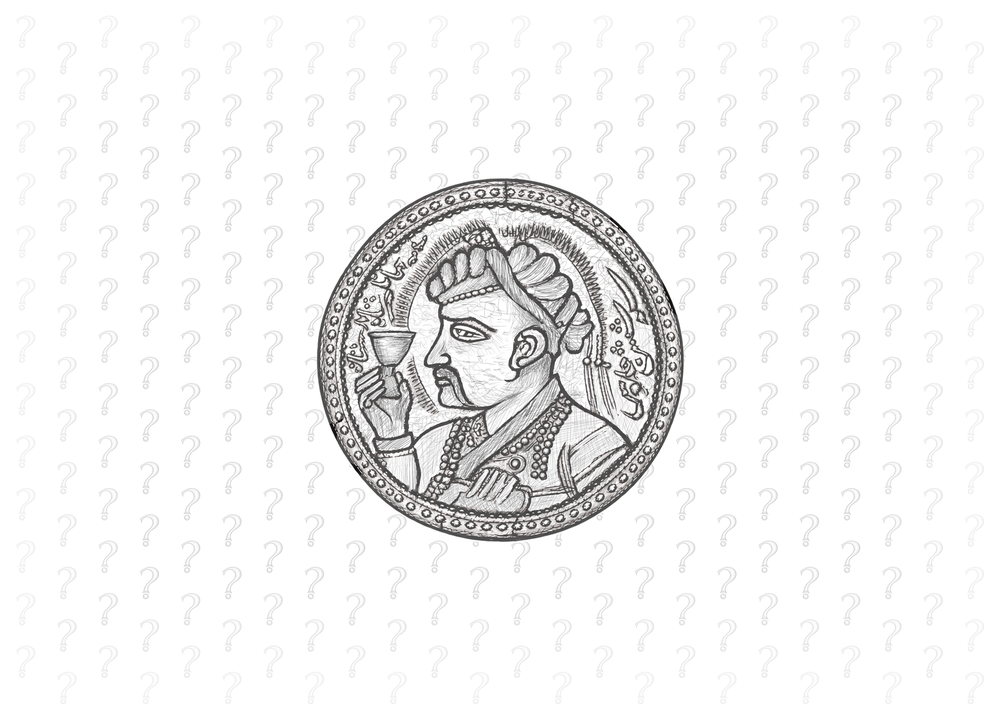
Wine-drinking was often practised “neither furtively and secretly on the one hand, nor in the common and general public on the other”. Thus, the Ottoman traveller Evliya Çelebi records “his first encounter with the Ottoman Sultan Murād IV as having taken place at a royal party where wine was consumed (Evliyā himself abstained), terminated by the mid-afternoon prayer, followed by a recitation from the Qur’ān.” Another example is the jade wine-jug of the Mughal Emperor Jahangir, which bears this inscription on the lip:
God is Most Great! The King of the Seven Lands! The Emperor of Emperors who spreads Justice! The Knower of the Signs, Real and Metaphorical! Abū-l-Muẓaffar Nūr-ud-Dīn Jahāngīr, the King, son of Akbar, the King! Muslim-Warrior!
Although shari’a prohibits drinking wine, Ahmed argues this wine-jug should be seen as Islamic regardless of whether one approves of it; refusing to do so would impoverish and distort our understanding of the wine-jug, the Mughal emperor, and his views on drinking.
Irfan Ahmad criticises Ahmed’s approach, arguing “that his thesis is less than sophisticated, even pedestrian, and one emanating from the corpus of dominant Orientalism”. As part of his denunciation, Irfan Ahmad describes himself trying beer for the first time as a young man in a Bombay pub: “The first sip was hard to swallow. Soon I almost threw up, saying in disgust that it tasted like goat or cow urine…I felt mostly awful for having violated the values my parents and the madrasa I studied at had imparted.” He compares this agonising experience to (the other) Ahmed’s story of the Cambridge don and the smiling, wine-drinking Muslim academic. Irfan Ahmad writes that during British rule in India, drinking “became a sign of being ‘modern’ for Westernizing elites… to the ‘uncivilized’ world, modernity meant wine and Christianity”. He therefore asserts that Ahmed’s discussion of wine is “characteristically Christian and secular”.
This is not particularly persuasive. After all, wine is ubiquitous in ghazal literature, as Ahmed correctly notes, as the “pre-eminent and pivotal image for the deepest experience of the meaning of human existence in relation to the Divine”. Modern Muslim readers of ghazal poetry often insist that the wine is purely metaphorical. This contradicts the historical evidence: it “ignores the widespread practice of grape-wine-drinking as a persistent and standard feature in the history of societies of Muslims… in which the ideal setting for wine was in a gathering of friends with the accompaniment of poetry and music.” In poetry, wine is often only metaphorical, but it is also regularly real. At times it is both real and metaphorical, and is used to criticise legal norms and discourse. Consider this verse by Hafiz:
Ḥāfiẓ; drink wine, live in non-conforming-libertinage, be
happy, but do not
Like others, make the Qur’ān a snare of deception.
Or this one:
If the jurist admonishes you against love-play,
Give him a bowl of wine; tell him to loosen his mind!
‘It is not so easy and trifling to call me an Unbeliever’
The question of how to view arguments and actions throughout history that contravene the shari’a and even the Text of Revelation is what makes Ahmed’s approach particularly controversial. In his recent book The Islamic Secular, Sherman Jackson writes that he and Ahmed “are in full agreement on… gaining more explicit recognition for the Islamic value of contributions from outside the sphere of authority represented by the fuqahā’-jurisprudents”. But Jackson strongly criticises the notion that wine-drinking could be described as Islamic, writing that Revelation is “the deliberate proclamation of God as a willful and ultimate agent who addresses what God pleases to address in the way that God pleases to do so”, and that “even were we to concede the possibility of contradiction between what God creates and what God commands, this would not automatically privilege creation’s truth over that of Revelation… The Islamic Secular simply does not recognize any ontologically ‘higher truth’ that can independently or automatically override scripture.”
In Jackson’s view, Ahmed’s notion of Pre-Text calls to mind an “ancient pagan notion of pre-existing Truth” which Islam finds “problematic”.
Compare this, however, to Ahmed’s own conception of the Pre-Text:
there is no essential difference and no semantic disconnect between the truths of Pre-Text and Text: rather, they are connected in a hierarchical communicative continuum of (God’s) Reason; they are both part-and-parcel of the logic and structure and reality of the meaning(s) of Revelation.
Ahmed further writes:
That the Qur’ān/Text of the Revelation is true but does not encompass all the Truth of the Unseen Pre-Text of Revelation is accepted by all Muslims. Indeed, the Qur’ān does not even claim to possess all the Truth of the Unseen made available in the Seen, saying, for example, ‘On Earth are signs for the sure; just as there are within your own selves: do you not see?’”
The historical disagreement among Muslims, Ahmed tells us, has been over whether only engagement with the Text can lead to knowledge of higher truths about God and the Unseen (this was the view of kalam-theologians) or whether Truth can be accessed without recourse to the Text (this was the view of many philosophers and Sufi practitioners). Likewise, Ebrahim Moosa argues that the discourse of Islamic law has always accepted the premise of the Pre-Text, although it holds that only Prophets can directly access such higher truth, or that, if accessed, it is not socially actionable. Jackson’s approach, while clearly suitable to his project of articulating an Islamic Secular realm in today’s world, does not quite allow us to properly comprehend historical Islam.
This is because many philosophers and Sufis whose ideas contradict the Text of Revelation and the shari’a have not only been important among historical Muslims, but have also influenced the shari’a, the ulema, and legal discourse.
Consider Ibn Sina, who argued that there will be no bodily resurrection and no physical paradise or hellfire, views jurists and theologians widely condemned as heretical. Ibn Sina composed his rejoinder in verse:
It is not so easy and trifling to call me an Unbeliever;
No faith is better founded than my faith.
I am singular in my age; and if I am an Unbeliever—
In that case, there is no single Muslim anywhere!
Ibn Sina’s famous conceptualisation of God as the sole Necessary Existent, later accepted by most philosophers, “became the operative concept of the Divinity taught in madrasahs to students of theology” from the Balkans to Bengal. Thus, mainstream theology “in the millennium-long age of the madrasah conceptualised God on a philosophical foundation whose logic and epistemology” had led Ibn Sina “to conclusions that were condemned as exemplary Unbelief.”
A particularly strong criticism of Ahmed is that he engages minimally with juridical discourse. Jackson argues forcefully that Ahmed imputes a totalising impulse to the ulema that many of them did not actually have. Ahmed’s engagement with juridical ideas in the book is certainly limited, but he does not caricature the ulema. In fact, he points out that Ibn Rushd in the 12th century “was, on the one hand, the Chief Judge of Cordoba administering the Revealed law, and on the other hand, a philosopher writing on the hierarchy of T/truth (where law, as we have seen, ranked down the scale)”.
In the 16th century, the “greatest Chief Jurisconsult of the Ottoman Empire, the Şeyh-ül-Islām Ebü-s-Suʿūd”, issued a legal ruling in response to the question:
Is it permissible that the people of Unity from amongst the followers of the Sufi path carry out zikr [God-remembrance rituals] in mosques and other gatherings by making rhythmic movement?
The Chief Jurisconsult responded:
Knowledge of Divine Truth is a limitless ocean. The Sharīʿah is its shore. We are the people of the shore. The great Sufi masters are the divers in that limitless ocean. We do not argue with them.
Neatly dividing Islamic history into separate realms of orthodoxy and heterodoxy is simply not possible; alternative discourses often influenced law. This brings us to one of the most electrifying and important parts of What is Islam?: Ahmed’s discussion of law and politics.
Redefining ‘Islamic Law’
We are conventionally told that shari’a, the law of the jurists, is Islamic law, while “ruler’s law” (siyasat/qanun) is essentially secular. According to one (currently influential) historical narrative, before modernity, Muslim rulers were subordinate to shari’a, and jurists highly limited the scope of ruler’s law. In reality, however, Ahmed shows that rulers’ law saw itself as using human reason and custom to seek to fulfil the “Divine purpose” and, in that sense, resembled a sort of natural law, in the assumption that “the Divine purpose - the preservation of dīn, life, intellect, family, property and honour - can be identified from the observation and experience of the natural behaviour of the human being in the world, and can be fulfilled on the basis of laws made from the basis of that rational identification.”
Moreover, rulers’ law, which Ahmed describes as Islamic, made up a significant proportion of the law applied in society. This was not only true in Islam’s post-formative period. The first Caliphs of Islam adopted and adapted a vast body of Byzantine and Sassanian imperial law and local custom (including taxation methods). “Thus, in continuing to make ruler’s law down the centuries, later Muslim rulers were simply emulating their Rightly-Guided forbears,” Ahmed argues.
In the Ottoman and Mughal empires, akhlaq literature shaped political theory and, by extension, law. Consider the Akhlaq-i Jalali, a masterpiece of political theory by Jalal-ud-Din Davvani (d.1506), read by both Ottoman and Mughal elites. Davvani describes the ruler as “distinguished by Divine support” and tasked with ordering the “collective welfare” of his people. The ideal ruler is described as the “Shadow of Allah” and “Deputy of the Prophet”. This idea of Islamic kingship was “standard and operative” from the Balkans to Bengal. A century and a half later, Muhsin Fani Kashmiri, a courtier of the Mughal Emperor Aurangzeb in the late 17th century, described the ruler as capable of determining the “specificities of the law according to the needs for welfare,” so long as he does not “negate any universal shari’at principle.”
The Ottoman state employed jurists as officials and even actively intervened in Hanafi legal doctrine. As Guy Burak has written: “The sultan . . . claimed authority to regulate the legal content that members of the imperial establishment were to apply”, creating a “specific version of the Hanafi school.” Beyond creating his own body of law (for example, when Sultan Suleyman “The Lawmaker” limited the legal rate of interest to 11.5%), the Ottoman Sultan could also choose between different juridical interpretations, “thereby effectively acting as jurist himself”.
Reaching back further, Ahmed notes that “probably the single action of most far-reaching consequence for legal doctrine in the history of Islam was not the act of a jurist or collection of jurists, but was a Sultanic Initiative”: in 1265 the Mamluk Sultan Baybars appointed Chief Judges from all four Sunni legal madhhabs. This momentous act helped create the “legal culture where the jurists of the four Sunni madhhabs of fiqh came to accept—as a matter of law—the validity of each other’s respective legal rulings even when those rulings were in outright disagreement.” As Ahmed sums it up: “The plural orthodoxy of jurists’ law owes its historical institutionalization to the intervention of Sultanic law.”
The Sweep of Modernity
Core to the argument of What is Islam? is that modernity has seen an effective “downsizing” of Revelation in the minds of most Muslims. What is distinctively modern, Ahmed explains, “is not the idea that the Pre-Text is unknowable save through the Text, but is rather the fact that this conceptualization of reality has, by force of the encounter with the Western modern, become the dominant conceptualization”. A major reason for this was modern science’s empiricism, which “generated in societies of Muslims (as it did in societies of non-Muslims) a turning-away from the idea of the Unseen World as an accessible object of real knowledge”.
Moreover, the imposition through colonialism and modern states of a religious-secular binary, with religious being the separate domain for that which is not scientific human reason (i.e., the domain of Revelation) and secular being the separate domain for the exercise of scientific human reason (i.e., of philosophy and natural science) has led - even when the binary has not been accepted outright in modern societies of Muslims - to the undermining of the claim of projects of reason to be acting in the same domain and with regard to the same goods as projects of Revelation.”
This means that “when modern Muslims encounter statements of Islamic meaning that are made in terms of the hermeneutical engagement with Pre-Text”—examples include the ideas of Ibn Sina, the poetry of Hafiz and miniature paintings—they are generally “unable to recognize or make sense of these statements as Islam”. Modern Muslims are therefore largely “unable to establish a coherent conceptual relationship between modern Islam and pre-modern Islam”. Salafism, in Ahmed’s telling, is just part of this: its attempt at “de-historicising” Islam aims at “re-locating Islam to a moment before Muslims had the opportunity to complicate it with their various and contradictory attempts at meaning-making down the centuries.”
At times, Ahmed’s narrative lacks nuance and texture. Fitzroy Morrissey has recently examined a “movement to renew Islam in 18th-century Islamic thought” rooted in Sufism but with a new egalitarianism and a fresh emphasis on rejecting the “blind emulation of scholarly authority”. Crucially, Morrissey notes that these “thinkers’ knowledge of developments in modern European thought was minimal at best, and their impulse to renew Islam came not from Western pressure, but from a sense of internal decay”. Morrissey cites Abd Al-Ghani Al-Nabulusi, a scholar in Ottoman Damascus in the late 17th and early 18th centuries. He attacked the puritans of the day and defended the highly controversial practice of drinking coffee, as well as smoking tobacco, listening to music and visiting the graves of saints. The novel twist, Morrissey writes, was that Nabulusi criticised “those who conceal God’s commandments from the masses on the basis of the esoteric principle that the divine law contains ‘hidden knowledge’”.
At the same time, Nabulusi was heavily influenced by Ibn ‘Arabi and affirmed that there was indeed a hierarchy of knowing: “Knowing God through [what the Sufis call] spiritual unveiling and direct witnessing is a higher form of knowledge than knowing Him through rational inference and demonstration, which in turn is a higher form of knowledge than knowing Him through unthinking emulation and submission.” Yet he introduced an unusual emphasis on the notion that ordinary Muslims could be taught difficult ideas, which he demonstrated by delivering public lectures on Ibn ‘Arabi’s metaphysics at the Umayyad Mosque. As Morrissey writes:
In [Nabulusi’s] work, then, we see the germ of the idea of an anonymous reading public that was to emerge in full force in the Arab world later, in the 19th century, and was an important part of the dissemination of Enlightenment ideas.
According to Morrissey, Nabulusi’s thought contained the “seeds of an indigenous Islamic Enlightenment”. This intriguing idea requires much further exploration by scholars. Two centuries later, as a young man, the 20th-century Indian poet-philosopher Muhammad Iqbal railed against the old hierarchical approach to Islam, which he labelled a Persian corruption, a “false Mysticism”. In 1917 Iqbal denounced a
spiritual Aristocracy pretending to claim knowledge and power not open to the average Moslem… Remember that Islam was born in the broad day-light of history… Do not listen to him who says there is a secret doctrine in Islam which cannot be revealed to the uninitiated.
Iqbal concluded:
Moslem youngmen! Beware of the mystifier. His noose has now been too long round your neck. The regeneration of the Moslem world lies in the strong uncompromising ethical Monotheism which was preached to the Arabs thirteen hundred years ago. Come, then, out of the fogs of Persianism and walk into the brilliant desert sunshine of Arabia.
This was a passionate and quintessentially modern Islamic expression of egalitarianism. But Iqbal himself was also deeply (and increasingly so throughout his life) influenced by Sufism, even as he criticised Sufis. He came to argue that mystical experience, while entirely real, must be “open to critical scrutiny like other aspects of human experience”. Indian ulema at times denounced Iqbal’s poetry as heretical, and he expressed his most heterodox and daring ideas in Persian verse, which by then was much less widely circulated than Urdu poetry in India, and so less likely to result in his being condemned.
In What is Islam? Ahmed explains that Iqbal’s celebrated focus on “Selfhood”, on the exploration of the Self, was in fact a remobilisation of an old Persian concept. Iqbal “sought to make of every Muslim self-realizer of Truth”, as displayed in this verse of his:
This is the purpose of the revolutions of day and night –
That your Self may reveal itself to you.
And this one:
Raise your Self-hood so high that at each turn of fate,
God Himself should ask of man, “Tell: what would you dictate?”
Iqbal is an important philosopher to consider alongside Ahmed’s work. His arguments were often highly novel, but they rested on serious engagement with older thinkers in the Balkans-to-Bengal complex, through his reading of Persian poetry. Iqbal believed that Islamic philosophical and political thought, which needed to operate freely, must be protected from orthodoxy. At the same time, orthodoxy had to be protected from “religious adventurers,” whom he saw as given free rein by the British in India and capable of fatally undermining it. As Faisal Devji puts it:
The conventional aim of esotericism, of course, was to protect the autonomy if not freedom of philosophical and political thought from theological authority and popular opinion. But by refusing to deny the latter altogether esotericism became its protector as well.
Iqbal, then, is an example of an influential modern figure for whom Revelation was not “downsized”. It was through poetry that the older understandings remained; Iqbal engaged in a Sufi-philosophical discourse which had become, by that point, unfashionable and almost irrelevant to politics in British India. He was a thinker out of time.
What now for the Modern Muslim?
Some Muslims academics argue that modern changes in Muslim understandings of Islam have been necessary and even positive. Mohammad Fadel argues that modern Muslims
require a theology that is Islamic and democratic. Given this historical reality, it would be shocking if modern Muslims did not gravitate toward a theology that made law central to what it means to be Muslim. Democratic modernity, whatever else it means, reflects an egalitarian ethos.
Ahmed grapples with this idea, noting that “Modern society, made public by the technologies of print and internet, is the society of avowedly egalitarian public discourse.” He writes:
“whether or not one subscribes to the pre-modern logic of the confining of more complex truths to private society on the grounds that the very complexity of these truths is likely to derange and disorder the society of the general public (and putting aside the practical feasibility of the application of such a principle in the modern age of information technology), it is rather difficult to argue that the very publicness of discourse in modern societies of Muslims has led to an expansion in the normative possibilities of discourse and living in terms of Islam.”
The problem, in Ahmed’s view, is that modern reformist Muslim discourse has largely been about “rethinking the Islamic state by rethinking Islamic law, and not about rethinking theology, philosophy, ethics, poetics, and Sufism as a hermeneutical means to modern Islamic norms.” He argues:
recognizing the philosophical-ethical conceptualization of ruler’s law as Islamic law should significantly affect and influence the conceptualization by modern Muslims of the norms and values of the project of the law.
Ahmed further bemoans that modern “Islamic economics” and “Islamic finance” tend to refer to “historical fiqh discourse, rather than… the human and social values expressed in books of akhlāq-ethics”.
A rare example of modern Muslims actually engaging with the complete matrix of Divine Revelation is the abolition of slavery. When “God assumes in the Qur’ān the existence in society of slavery and legislates with slaves in mind,” Ahmed asks, “how does it make modern interpretive sense to do what all modern societies of Muslims have done and abolish slavery?” The abolition of slavery was seen as a “fulfillment of a higher divine/Pre-Textual value and purpose”. Ahmed wryly notes that the counter-arguments
that to abolish slavery is to deny the Muslim his/her apparently God-approved right to own slaves (and is also to deny the slave-owning Muslim the right to expiate his/her sins by freeing slaves) seem not to have had much purchase in the sensibilities of modern societies of Muslims. Here, a Textual form has successfully been done away with because of a presumptive ‘Pre- Textual meaning’.
If modern Muslims applied this approach to other matters, Ahmed suggests, it would “considerably reconfigure the hermeneutical terrain of contemporary Islam”.
What is Islam? is a complex, unique and ultimately magisterial work whose arguments and implications have not yet been fully appreciated (or indeed, understood). Ahmed towers above his critics. It is difficult to argue, in light of his scholarship, that either academic, Western political or Muslim discourse on historical Islam has succeeded in adequately understanding or representing it. Much of Islamic history remains shrouded in mystery, and so Ahmed’s work remains profoundly important. Simply put, when we gaze into the past, we still do not understand what we are seeing. The consequences of this, Ahmed argues powerfully, are immense:
By not employing language appropriate to the meaning at stake, and thus by not recognizing Islam for what it is, we - Muslims and non-Muslims - at best misrepresent, and at worst commit an outright injustice to the human and historical existences and endeavours of one-fifth of humanity. We also do an injustice to ourselves by preventing ourselves from apprehending and benefiting from what those existences and endeavours have to offer us by way of understanding and experiencing the human predicament, as well as from apprehending and benefitting from what those existences and endeavours have to offer us by way of making meaning for ourselves.
“It is a mistake to think of the Islamic as one of the several ways of being religious,” declared the scholar Wilfred Cantwell Smith in 1981. “Rather, for fourteen centuries the Islamic has been one of the salient ways of being human.”
As Ahmed himself concludes: “Let us understand, apprehend and benefit from the importance of being Islamic.”
Words: Imran Mulla is the author of The Indian Caliphate: Exiled Ottomans and the Billionaire Prince (2025) and the co-author with John Holmwood of The Crescent and the Commons: Inside the New British Muslim Politics (2027).
Further Reading:
- Ahmad, Irfan, ‘Drinking Secularism: A Critique of Shahab Ahmed’s What is Islam?’, Religion and Society: Advances in Research, Volume 15, Issue 1, 2024.
- Ahmed, Shahab, What Is Islam? The Importance of Being Islamic (Princeton University Press, 2015)
- Fadel, Mohammad, ‘The Priority of the Political: Politics Determines the Possibilities of Islam’, Marginalia, 22 August 2016.
- Iqbal, Muhammad, ‘Islam and Mysticism’, The New Era, 28 July 1917.
- Jackson, Sherman, The Islamic Secular (Oxford University Press, 2024)
- Morrissey, Fitzroy, ‘Islam’s Own Enlightenment’, Engelsberg Ideas, 14 October 2026.
- Morrissey, Fitzroy, The Renewal of Islam: Thinkers and Believers of the Modern Era (Bloomsbury, 2026)