
In the mid-2000s, Carlos Ghosn sought a place to expand production. He had become one of the automotive industry’s best-known executives as the architect of the Renault–Nissan alliance and the manager credited with returning Nissan to profitability. Renault’s low-cost Dacia programme was outrunning the capacity of its Romanian plant, and the company was studying expansions in Romania, Türkiye and Slovenia.
Romania offered an established production base close to customers in Europe’s large car market, with suppliers already serving Renault’s factory. Then Morocco’s prime minister, Driss Jettou, asked to see Ghosn. In Ghosn’s later account, Jettou came for coffee and made a direct proposition: don’t put the next factory in Eastern Europe; put it in Morocco instead. The Moroccan state would do what was necessary to make the project competitive.
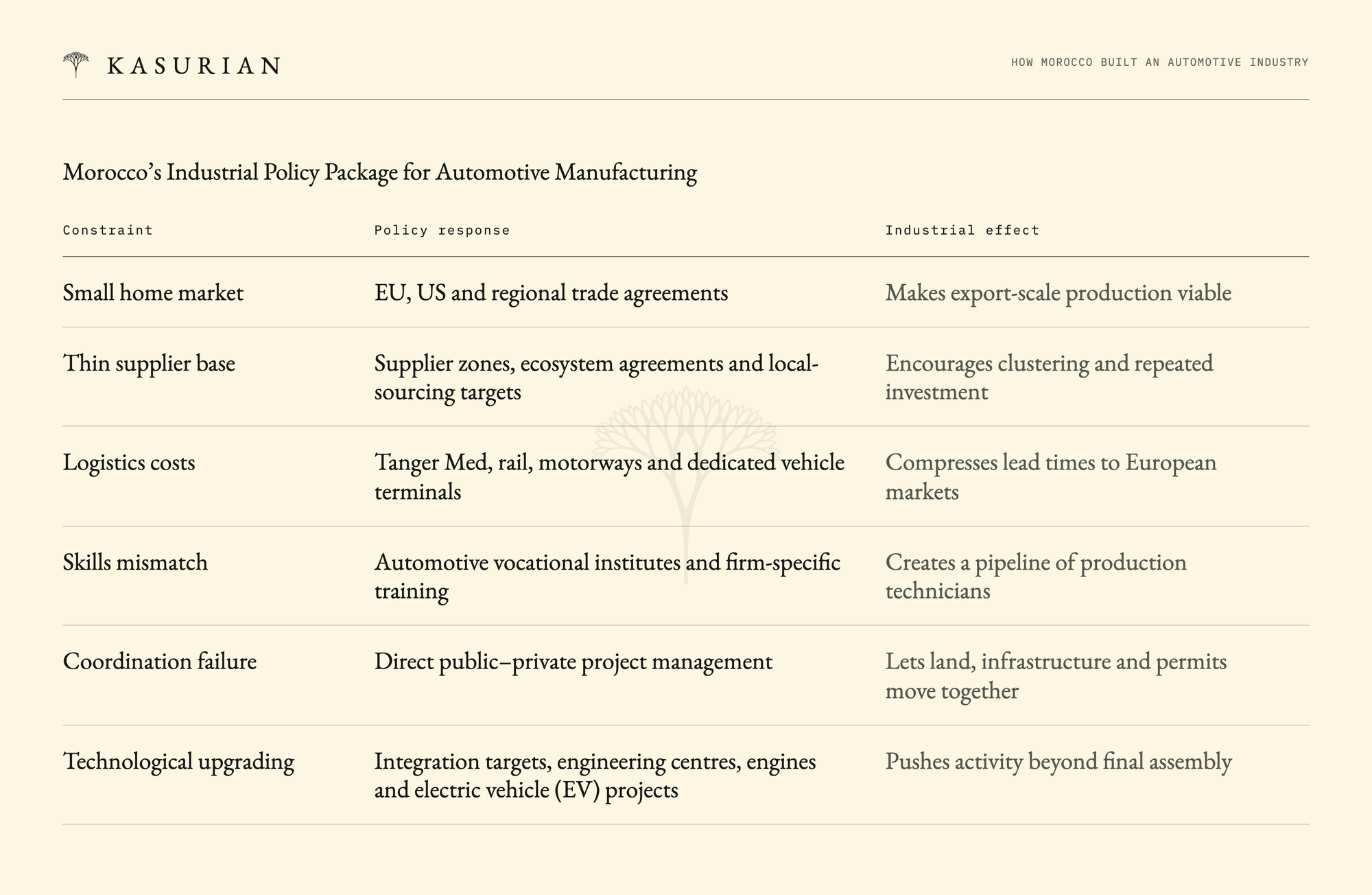
Morocco’s small domestic market offered Renault little room to grow, and its supplier network was much thinner than those around the company’s European factories. Jettou had to persuade Ghosn that the country could support production on a scale it had never attempted. He offered state support to put the conditions for large-scale production in place. Renault would become the anchor of an export industry, with public investment organised around the factory and the suppliers it could attract.
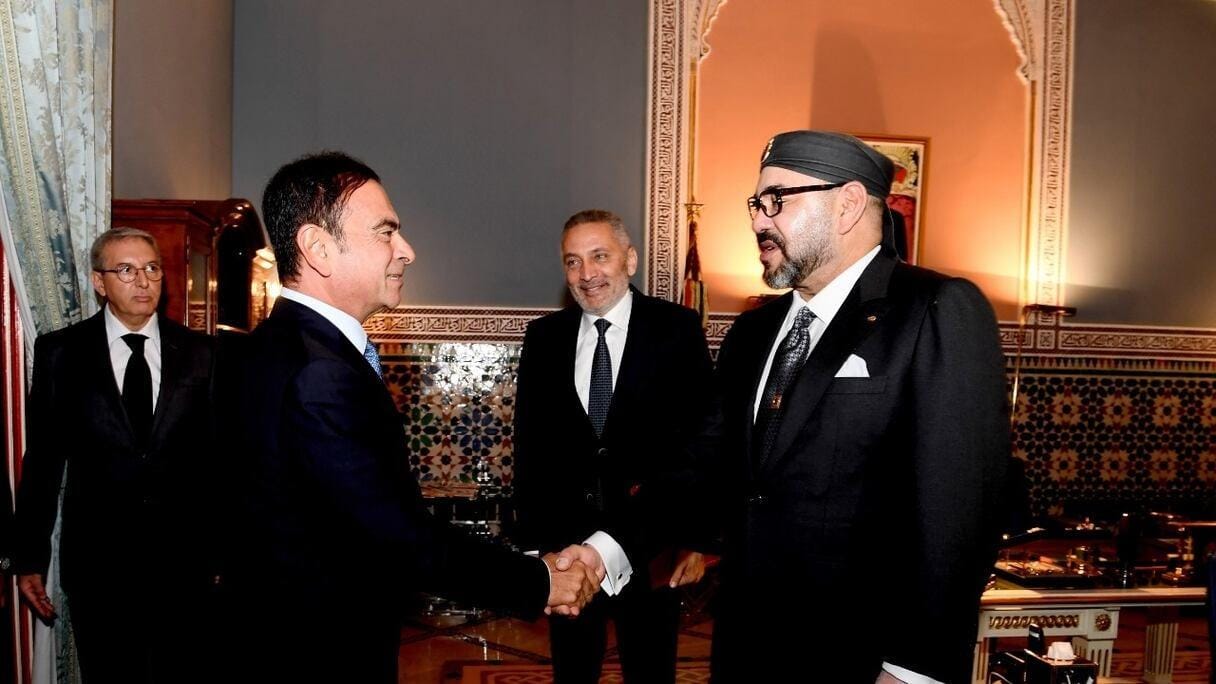
Renault and the Moroccan authorities signed the protocol of intent in September 2007 in the presence of King Mohammed VI. The company established Renault Tanger Méditerranée the following year and began production in 2012. By 2024, Morocco’s automotive exports were worth about US$15.9 billion and roughly a third of Moroccan goods exports. Renault and Stellantis now operate alongside hundreds of suppliers, with factories extending from Casablanca to Tangier. The Tanger Med port handled more than 600,000 vehicles that year. Morocco is now Africa’s largest producer of passenger cars.
The result was one of the few industrial policy success stories of the 21st century. However, it also shows the limits of industrial policy in achieving structural transformation and broader developmental gains across Morocco’s economy and society.
Why Morocco’s First Automotive Industry Stalled
Morocco had tried to manufacture cars before. The Société Marocaine de Construction Automobile (SOMACA) was founded in Casablanca in 1959 as a mixed-ownership assembler, with the Moroccan state and foreign manufacturers among its shareholders. It initially assembled licensed Fiat, Renault, Austin and Opel models, among others. Output reached roughly 30,000 vehicles a year in the mid-1970s. Morocco pursued import-substitution industrialisation through a protected domestic market, where short manufacturing runs gave international suppliers little incentive to establish local production. The limited scale left little room for specialised component firms to develop, while manufacturers lacked the engineering workforce and logistics needed for large export orders. Liberalisation between the 1970s and 1990s exposed the model’s fragility, while cheaper imported used cars further pressured domestic production.
Renault gradually took control of SOMACA from 2003, turning the existing Casablanca operation towards export production. Renault reported output of about 10,000 vehicles at SOMACA in 2005 and projected that it would approach 100,000 in 2024, with two-thirds exported to around 70 destinations globally.
The larger change came at Melloussa, near Tanger Med, where Renault Tanger Méditerranée built a new factory to serve overseas markets from the outset. Its scale required a supplier base and workforce that could reliably meet export orders.
Building an Automotive Ecosystem
Morocco’s proximity to Europe and lower labour costs gave Renault reasons to consider investing. By the time negotiations began, the government was already developing the institutions and infrastructure that could support an export factory.
For the port and surrounding industrial development, the government created a dedicated institution. Established in 2002, the Tanger Med Special Agency (TMSA) received public powers over the port and its free zones. Its remit encompassed raising finance and developing and operating the industrial and logistics zones alongside the port. This placed responsibility for the sites manufacturers would occupy and the infrastructure serving them within the same organisation.
Coordination extended beyond TMSA. A World Bank study of Tangier describes the regional governor, the king’s representative, coordinating national public agencies, with regular meetings bringing public bodies and business representatives together. The study identifies technical capacity within the agencies as another contribution to implementation.
TMSA brought in specialist expertise through international procurement. In 2003, it awarded the first phase of port construction to a consortium comprising Bouygues, its Moroccan subsidiary Bymaro and Saipem. The contract covered design and construction, allowing the agency to draw on the contractors’ marine-engineering expertise. Experienced businesses also took responsibility for terminal operations: a 30-year concession awarded in 2005 brought together APM Terminals and Morocco’s Akwa Group, with the concessionaire investing in terminal equipment and facilities. Morocco was building its ability to commission and coordinate a complex project while drawing on internationally available expertise.
Morocco had an established national railway operator, the Office National des Chemins de Fer (ONCF), which had managed its network since 1963. Its responsibilities included building new lines and operating passenger and freight services. The government could therefore commission the port and factory connections through an existing organisation with railway experience. ONCF’s financing records show successive state capital contributions towards the Tanger Med connection, with funding also allocated specifically to connect Renault’s factory to the network.
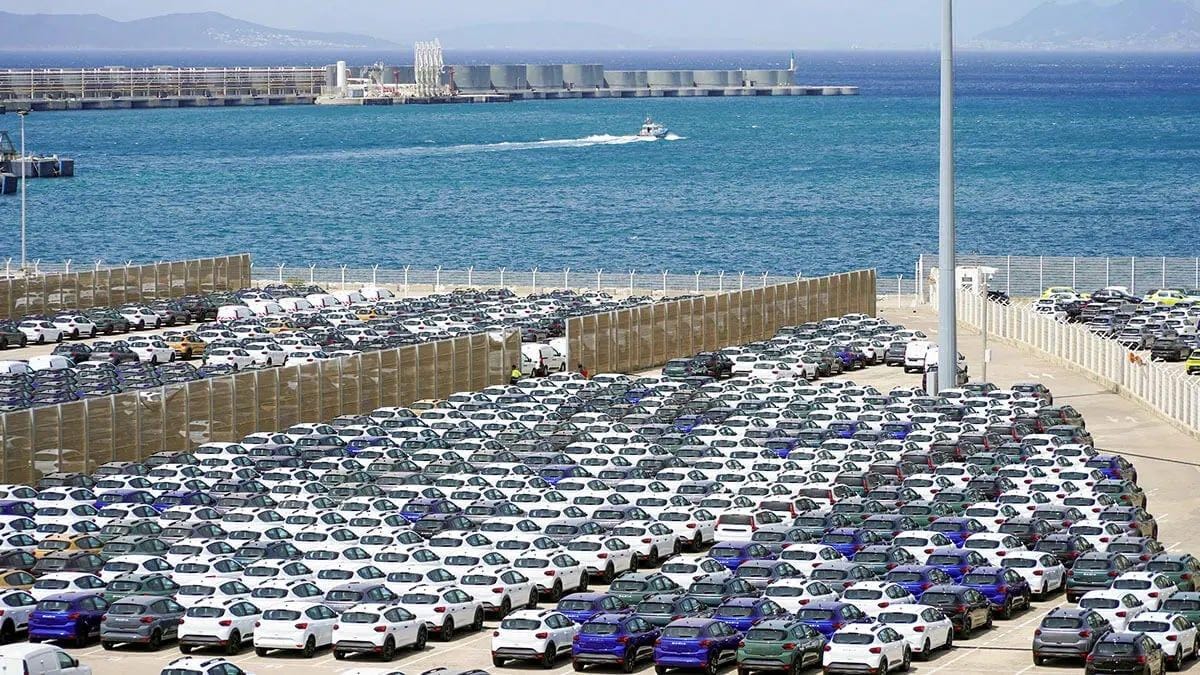
Tanger Med connected Renault’s Melloussa factory and its suppliers to European markets. Finished vehicles travel by rail to a dedicated terminal and onto ships serving European distribution networks, with some European ports reachable in under 48 hours. Coordinating transport, customs and production schedules made Morocco’s proximity commercially useful. In 2024, the port shipped 368,843 vehicles from Renault’s Moroccan plants and 170,519 from Stellantis at Kenitra.
The state also committed capital to the manufacturing venture. In 2009, the public financial institution Caisse de Dépôt et de Gestion (CDG), through its subsidiary Fipar, took a 47.6% stake in Renault Tanger Méditerranée, the company holding the project’s industrial assets. Renault retained the majority stake and responsibility for operating the factory. CDG sold its holding to Renault at the end of 2014, after the plant had entered production.
Workforce preparation followed a similar division of responsibilities. The Moroccan state financed the automotive training institute, while Renault designed it and managed its operation under a delegated public-service arrangement. The institute opened in 2011, before factory production began in 2012, allowing training to develop around the plant’s requirements. A financing agreement with the Agence Française de Développement (AFD), France’s development agency, also supported centres serving automotive suppliers in Tangier and Kenitra, extending the programme beyond Renault’s own workforce.
By October 2013, the institute had trained more than 4,500 young people since mid-2011. The institute tested recruits in mathematics, French and manual dexterity before directing them into production jobs, including welding and painting. The four-week programme described at the time trained groups of 200–250 people for specific production jobs, including work at suppliers such as SNOP and Valeo. Training continued as the factory developed: by 2022, the institute had delivered more than 2.6 million training hours, and workers had acquired skills in robot maintenance and vehicle electronics.
Morocco’s trade agreements allowed factories to serve markets far larger than its domestic economy. The European Union (EU)–Morocco Association Agreement, in force from 2000, gave Moroccan industrial goods tariff-free access to Europe while Morocco phased out its own industrial tariffs over 12 years. Its agreement with the United States entered into force in 2006. Rules of origin determined whether vehicles qualified for preferential tariffs, making component sourcing part of the export strategy.
From Anchor Firm to Industrial Cluster
Renault’s commitment gave suppliers a large customer around which to plan their own investments. Firms making components such as seats and wiring could establish operations near the assembly plant, helping build a supplier base other carmakers could also use.
Morocco drew on its experience with Renault to attract Peugeot’s parent group, now part of Stellantis, which signed an agreement with the government in 2015. On the Atlantic industrial corridor north of Rabat, the planned Kenitra plant would extend the industry’s reach, with plans for a research and development (R&D) centre and suppliers nearby.
The government continued negotiating with Renault as the production base expanded. Their 2016 ecosystem agreement set a target of 65% local integration by 2023 and included commitments to increase purchases of Moroccan-made components for Renault’s factories at home and abroad. The ministry and the company later published a progress report, making supplier development an explicit part of their ongoing partnership.
The Tangier factory produced its millionth vehicle in 2017 and set a record of 318,600 vehicles in 2018. Production at Kenitra began in 2019. In 2021, Renault reported that local integration had passed 60% and that its network of direct suppliers in Morocco had grown from 26 to 76. These figures describe production located in Morocco, including foreign-owned suppliers; they do not measure how much income or ownership remained in Moroccan hands.
Measured in dirhams, automotive exports grew to roughly three and a half times their 2014 value by 2024. Stellantis’s new Kenitra plant helped drive the post-2020 surge, doubling annual capacity to 200,000 vehicles in September 2020. European manufacturers also shortened their supply chains and directed more investment and procurement toward nearby Morocco. Office des Changes figures show that exports associated with vehicle construction rose from $4.4 billion in 2021 to $7.1 billion in 2024, while wiring exports increased from $3.3 billion to $5.4 billion.
Morocco was also exporting more complex components. Exports of engines and other parts that power vehicles rose from about $48 million in 2014 to $1.2 billion in 2024. The industry was developing beyond assembly, although production location tells us little about who owns the businesses or controls the technology.
How Moroccan Is a Moroccan Car?
Producing more components in Morocco creates opportunities for workers to develop skills and for suppliers to take on more demanding work. Foreign-owned factories can support both processes, while continuing to rely on technology and decisions made elsewhere. Their contribution to development therefore depends partly on how far Moroccan workers and businesses can use that experience to build their own capabilities.
Some firms have already expanded their work in Morocco. Lear, the US-headquartered supplier of automotive seating and electrical systems, operates a Moroccan engineering centre alongside its factories. Stellantis says its technical ecosystem involves more than 4,000 engineers and senior technicians directly and indirectly, and its Kenitra expansion includes engine assembly and machining. Renault has also expanded its engineering functions.
The Organisation for Economic Co-operation and Development (OECD) counted around 260 automotive factories and 173,000 direct jobs in 2023. It found only about 20 Moroccan-owned firms supplying carmakers or their major suppliers, while foreign firms occupied much of the more sophisticated production.
Domestic businesses face obstacles that the state helped major foreign investors overcome. The OECD finds that smaller firms struggle to obtain finance and receive payments on time, while informality and corruption complicate their operations. Morocco’s success in organising support around Renault raises a further question: how readily can a domestic manufacturer outside that network obtain the finance and institutional support it needs to expand and qualify for automotive contracts?
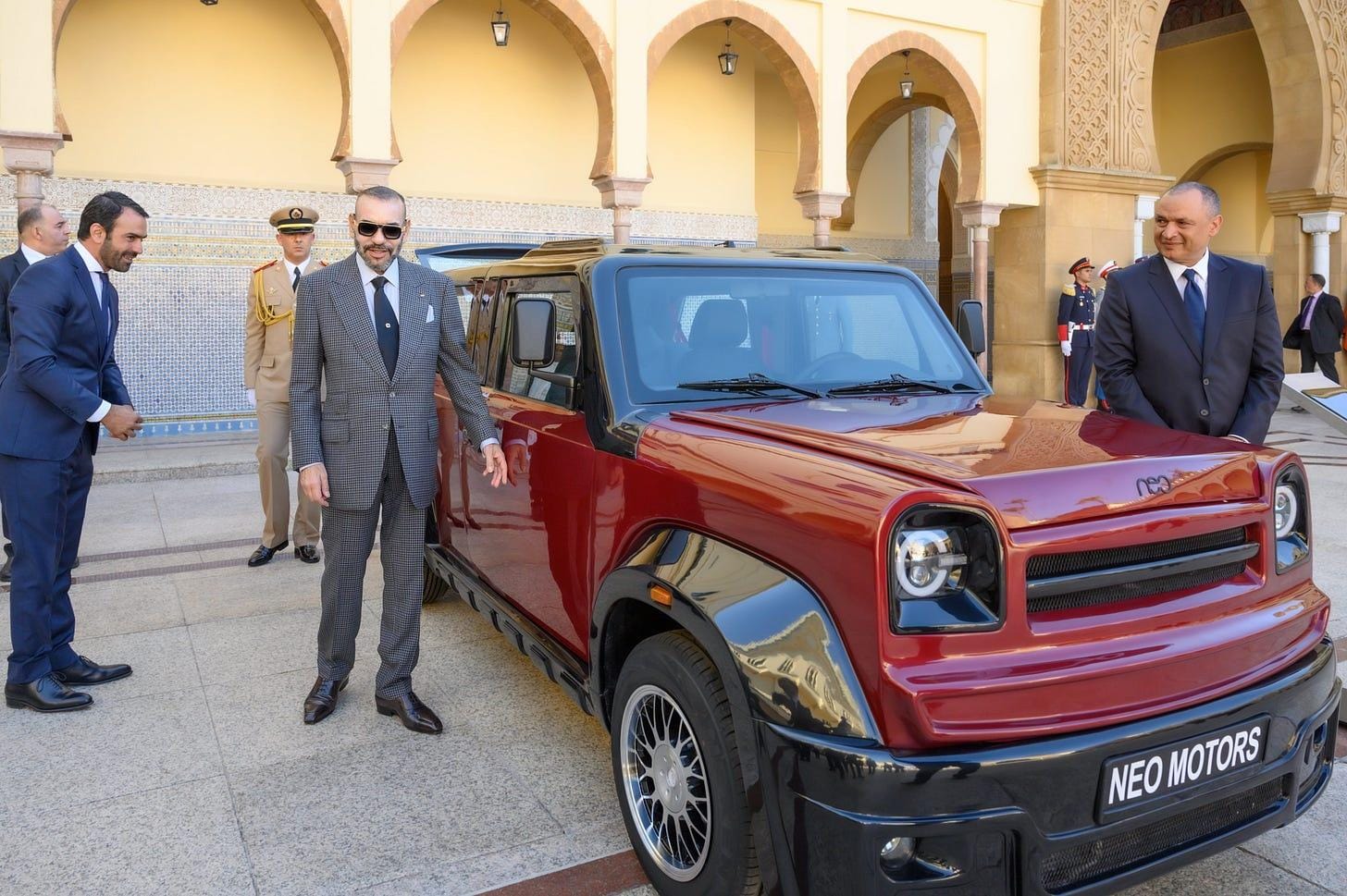
Neo Motors, Morocco’s first mass-market domestic marque, offers a small example of an attempt to build a locally owned manufacturer. The industry ministry describes a planned annual capacity of 27,000 vehicles, with 580 jobs and 65% local integration. These are project targets; their significance lies in the attempt to use the growing supplier base to develop a Moroccan-owned product.
Wider spillovers would become more visible if Moroccan firms used the experience gained in automotive production to enter other manufacturing activities.
Employment and the Limits of Industrial Growth
A 2019 International Labour Organization (ILO) study reported roughly 90% job placement among 474 graduates tracked by the automotive institutes in Casablanca and Kenitra, where programmes combined classroom learning with substantial time in companies. The same study put average wages in the automotive value chain at about 1.5 times the average across formal private-sector employment. These historical findings suggest that automotive work could significantly improve livelihoods, although they provide no measure of current starting salaries or placement rates.
The scale of these opportunities remains modest beside Morocco’s employment needs. The Haut-Commissariat au Plan, Morocco’s national statistical authority, reported overall unemployment of 13% in 2025 and youth unemployment of 37.2% among 15–24-year-olds. These figures describe a national jobs deficit that extends well beyond the automotive industry.
OECD data show that 400,000 new entrants join the labour market each year, while net job creation since 2000 has averaged only around 110,000 annually. The gap helps explain why even a substantial increase in automotive employment has left many young people with few prospects of formal work.
These figures show the scale of Morocco’s employment challenge, not the automotive industry’s effect on unemployment. The sector has created formal jobs, and evidence suggests better pay for some workers, but broader structural transformation depends on employment gains reaching far more people.
How far these gains spread will also depend on the industry’s ability to sustain production as manufacturers shift towards electric vehicles (EVs).
The EV Stress Test
The shift to EVs changes the production system Morocco spent two decades building. EVs need fewer moving mechanical parts than combustion-engine cars, and more of their value lies in batteries and the electronics and software that control them. Existing suppliers may find new customers or face falling demand for the components they make. The next test is whether the institutions that helped establish conventional vehicle production in Morocco can support the different requirements of battery and EV manufacturing.
Morocco has sought investment from Chinese battery companies to bring new production into the automotive cluster. In 2024, the government signed an agreement with Chinese firm Gotion High-Tech to build a battery gigafactory in Kenitra. The committed first phase is valued at about $1.3 billion and includes 20 GWh of capacity. A possible later build-out could reach 100 GWh and a total investment of about $6.5 billion, though the agreement does not commit the company to that full expansion. Subsequent financing documents describe a smaller initial project: the African Development Bank’s July 2026 project summary identifies a 10 GWh battery-cell factory.
China’s BTR has announced a cathode-materials plant, while other battery-component investments are under development. Stellantis has already built battery-electric micromobility products at Kenitra. At the inauguration of its Kenitra expansion in July 2025, Stellantis reported that charging-equipment production had begun and outlined plans to reach an annual capacity of 535,000 vehicles, including 135,000 micromobility vehicles. It also set a target of 75% local sourcing by 2030. Renault began assembling the hybrid Dacia Jogger in Tangier in 2024, adding hybrid production alongside the country’s early battery-electric projects.
The existing cluster gives Morocco a starting point for this transition, as manufacturers can draw on an experienced workforce and established export connections. Battery production nevertheless brings new technological dependencies, and the investments announced so far leave important questions about how much work will take place locally. Sustained production would provide stronger evidence of the cluster’s ability to adapt.
Development Beyond Industrial Policy
Morocco’s automotive industry is a genuine industrial policy success. The state helped turn a small assembly industry serving the domestic market into an export-oriented cluster. Established public institutions worked alongside agencies created for the task, drawing on foreign expertise to deliver infrastructure and prepare production. Renault’s investment gave suppliers a major customer, while continued public-private cooperation helped deepen the production base and attract more manufacturers.
However, the gains have spread unevenly. Relatively few Moroccan-owned firms have entered the supplier networks, and automotive employment remains modest despite the country’s need for jobs. Export growth also leaves unanswered questions about the returns on the public resources committed to the sector and the extent of spillovers into other manufacturing industries.
For those interested in development, Morocco’s experience shows how a state can build its capacity to deliver industrial policy through sustained work on particular investments. Public institutions gained access to specialist expertise and organised support around manufacturers’ requirements. The difficulty of extending comparable opportunities to domestic businesses helps explain why an internationally competitive industry can coexist with limited structural transformation.
What happens next will become clearer as employment and wages change and Moroccan suppliers take on more demanding work. Deeper localisation would matter especially where it allows domestic firms to develop engineering capabilities they can use beyond a single customer or industry. The battery and EV projects offer a further test of the system Morocco has built: whether it can bring new technologies into sustained production at scale, and whether the resulting opportunities reach more of the economy.
Words: Yasin Atlassi is a historian of technology, focused on how tools and infrastructure shape society, culture, and politics.